
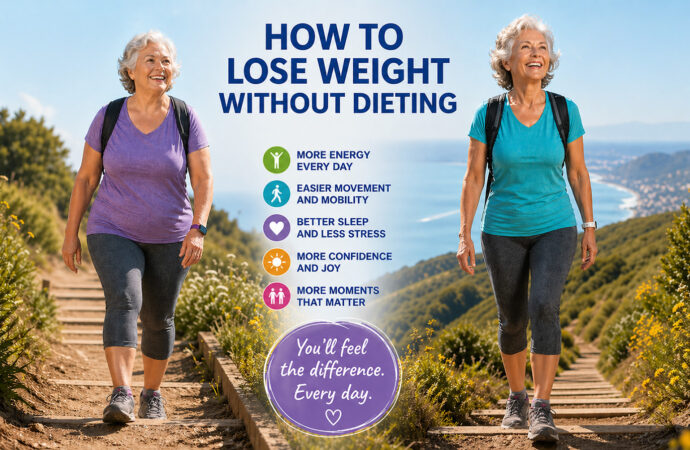
Have you added another pound or two to your weight with each candle that you’ve added to your birthday cake?
If so, you’re not alone. It’s a widespread problem for seniors. (No pun intended.)
Weight, like age, has a funny way of sneaking up on you. While you may still like to think of yourself as a physically fit 39-year-old, your scale and mirror tell a different story.
Trifecta of Weighty Issues
As we age, our metabolism slows down, which means we burn fewer calories.
Most people become less active as they age, too. Instead of cleaning the house or doing the yardwork yourself, you may be hiring other people to do tiring, difficult and calorie-consuming chores.
You may be eating more, or eating more fattening foods, too. Now that the kids have flown the nest, there’s more pizza and ice cream left for you. Or, perhaps, more money to spend on high-calorie take-out meals or on eating out.
Overeater’s Dilemma
Your mirror, scale – and maybe your doctor – are telling you it’s time to shed the extra pounds you’ve picked up over the years.
But dieting implies depriving yourself of foods you enjoy. Counting and recording the calories in every bite of food you eat is time-consuming and annoying. The starvation diets and fad diets you’ve tried in the past didn’t work.
Heck, just thinking about dieting and planning low-calorie meals makes you want to grab a cookie or three.
You don’t think the new diet drugs are right for you, either. You think of them as being for people who are much more overweight than you are, and you worry about their long-term safety.
So, what can you do? Here are 18 practical ways for seniors (and younger people, too) to lose weight and reduce food intake without feeling deprived, stressed, or irritable.
How to Lose Weight Without Dieting
Let’s be real. To lose weight, you’ll have to consume fewer calories and do more to burn them off. But if your weight isn’t a serious and immediate health threat, you can lose weight without going on a strict diet. Here’s how:
1 – Start with a Medical Checkup
If you don’t already have regular medical checkups and blood tests, start with a visit to your primary care physician to find out if there are high blood sugar, cholesterol or other concerns that need to be addressed in addition to your weight.
2 – Change your Mindset about Weight Loss
Don’t think about “going on a diet,” depriving yourself of foods you love, or losing a specific amount of weight. Instead, motivate yourself to lose weight by focusing on things you’ll enjoy when you weigh less. For instance,
- I’ll look better in photos
- I won’t feel self-conscious about food I order when I’m eating out with friends
- I’ll have less joint pain
- It will be easier to walk up a flight of stairs to play catch with my grandkids
3 – Trick Yourself into Losing Weight
Don’t try to flip the switch on your eating habits all at once. You didn’t gain all those extra pounds in a month. You’re not going to lose them that way, either. Simple changes in your lifestyle and food choices today can help you shed the extra pounds the same way – little by little. An added benefit: those simple changes will help you keep the extra weight off, too.
4 – Know How Many Calories Are in the Foods You Eat
Yes, I said you can lose weight without counting and tracking every calorie you eat. But to make good food choices for the day and week, you need to be aware of calories and portion sizes.
For instance, one serving (one packet) of Quaker Instant Oatmeal Apples & Cinnamon cereal has 160 calories and tastes pretty good mixed with hot water. (No extra calories.) A one-cup serving of Kellog’s Raisin Bran Crunch with Raisins has 190 calories. Add a half cup of whole milk, and the total comes to 265 calories. (If you fill your cereal bowl, you’re probably eating more than one cup of cereal, too.)
5 – Practice Mindful Eating to Lose Weight
Mindful eating is a buzz phrase. Look it up on the Internet and you’ll fall into a rabbit hole of explanations that often go into the psychology of eating and talk about experiencing your food or having relationships with food. One well-known example talks about meditating on a single raisin and turning it over in your fingers before eating it.
What I mean by mindful eating is much simpler (and won’t make your fingers sticky). What I’m talking about is just paying attention to what you eat and when you eat it.
In other words, avoiding mindless eating.
For instance, are you rummaging around in the refrigerator because you’re bored, or because it’s nearly time to eat a meal? Are you skipping breakfast and then grabbing a donut when you pick up your coffee on the way to work? Helping yourself to a slice of cheese while you’re getting the stuff out to make dinner?
Shed calories and pounds by eliminating mindless eating.
6 – Fill Up with Water
Have a drink of water or some other no-calorie drink a half hour before a meal. The drink will make your stomach feel fuller, which can make you feel satisfied with less food when you eat your meal.
7 – Skip High-Caloric Juices
The 8 ounces of orange juice you gulp down in the morning has 103 calories and adds as much and 21 grams of sugar to your morning. That’s roughly 5 to 8 teaspoons of sugar – as much as you’d get drinking the same amount of regular soda. Save on calories and sugar by switching to an 8-ounce glass of low-sodium V8 juice. (45 calories and only 7 grams of sugar.)
8 – Trim Your Waist and Your Budget
Say no to bougie Frappuccinos, white mochas, and Vente Iced Chais. Every time you gulp down drinks like those you swallow $6 to $7 plus 15% or more of your recommended calorie intake for the day. Save money and calories by making your own coffee or tea flavored with low-fat milk and, if needed, artificial sweetener.
9 – Stop Rationalizing Your Indulgences
When you see a cookie or some other treat you want, it’s easy to justify eating it by telling yourself, “It’s just a couple of hundred calories.”
The problem: that little indulgence may actually be 300 calories or more. Gobble down those “couple of hundred” extra calories a couple of times a day, and you’ll add 600 or more unnecessary calories to your food intake for the day. Do that every day, and you’re consuming 4200 unneeded calories a day, or more.
One pound of body fat has about 3500 calories. You do the math.
The work around: Look at the goodie, and ask yourself if you really need those extra calories right now. If that question doesn’t make you say, “No,” then picture the treat sticking to your hips or belly where everyone can see it.
10 – Practice Portion Control
Food servings are often two to 5 times larger than they were a half century ago. Not surprisingly, the average body weight of adults has risen, too. A CDC report found that the men and women weighed an average of 20 pounds less in 1960 than they did the early 2000s.
Reducing portion sizes isn’t easy, If you try to drastically reduce portion sizes, you may feel like you’re depriving yourself and may not feel “full” after a meal. And then you’ll grab a snack or two to tide you over to the next meal.
Dodge the problem by cutting back little by little.
Start by seeing how the portions you serve yourself vary from the serving sizes listed on food packaging. Put the amount of pasta, rice, or cereal or other food you usually eat into your bowl or on your plate. Then grab a measuring cup and another bowl. Use the measuring cup to transfer the food from your bowl to the empty dish.
Had you dished out more than the portion size listed on the box or container the food was in?
Tackle portion sizes one meal at a time to get them under control. Begin with dinner, for instance. Cut back on the portion size of high-calorie components a little bit. When you are used to the slightly smaller portion, cut back again. Repeat until you reach the recommended portion sizes for the types of foods you’re eating at dinner.
Next, work on reducing portion sizes of your lunch or breakfast.
11 – Use Smaller Bowls, Plates, and Glasses
As portion sizes have grown over the years, so have the size of dinner plates, bowls and drinking glasses. Twenty-five to thirty years ago, dinner plates averaged around 10 inches in diameter. Today they’re 11 to 12 inches. Soup bowls, which were once 8 to 10 ounces now tend to be 12 to 16 ounces.
Use a bit of visual trickery to reduce portion sizes and eat less without feeling deprived. Put your food on smaller plates and in smaller bowls.
When a plate is filled with food, you expect to feel “full” if you eat it all.. When the “full” plate is an inch or two smaller than the size you normally use, you’ll feel full with less food and less calories.
Don’t have smaller plates? Use 10-inch paper plates until you get used to eating smaller portions. Or fill empty portions of your plate with lettuce or other low-calorie veggies.
12 – Skip the Wine or Beer with Your Meal
Like a lot of people, I enjoy having a glass of wine with dinner. I have a sweet tooth, so my favorites are White Zinfandel and Moscato. But then one day, I realized the amount of wine I was pouring into my large wine glass had about the same amount of calories as a similar sized serving of regular soda. So, I was adding thousands of unnecessary calories each month to my diet.
Instead of forbidding myself from having wine with dinner, I cut back on how often I drank it. I like ginger ale, so I started having glass of diet ginger ale instead of wine a couple of times a week. I didn’t miss the wine, so now, I drink ginger ale most nights.
13 – Keep Junk Food and High-Calories Snacks Out of Site
The old saying, “out of sight, out of mind,” works for food. The easiest way to avoid eating high-calorie snacks is to not buy them. But if you do buy them, keep them out of site. “Hide” them behind other items in the closet or fridge so you don’t immediately see them.
When you do have a snack, don’t grab the whole bag of chips and chomp on it while you’re watching TV or reading. Put a single serving in a bowl and put the rest back in the closet.
14 – Eat More Slowly
Don’t gobble down your food quickly. Doing so makes you eat more, because it takes time for your gut to signal your brain that you’ve eaten enough. You’ll consume fewer calories and still feel full if you eat more slowly.
Instead of scooping up a big forkful of food, pick at your meal. Cut your food into small pieces, then eat it slowly, one piece a time. Have a sip of water between each bite.
15 – Pre-Prepare Meals and Snacks
When you’re tired, or just don’t want to be bothered, convenience wins out. “Convenient” foods and take out are loaded with calories. Avoid those unhealthy calories by making your own convenience foods. Here are a few ideas.
- Cut up a small cantaloupe and store it in the frig for a quick, snack or breakfast food.
- Make extra salad at night and have the leftovers for lunch the next day.
- Hard boil some eggs to have ready for late mornings or to throw onto a salad.
- Cut up the veggies for stir fry when you’re making another meal and store then in the frig for the next day.
- Freeze extra portions of food or meat before you serve it. If the extra portions are put away before you eat, you won’t be able to help yourself to seconds (and more calories). Plus, you’ll have the time-consuming part of another meal for another day. For instance, say, you’re making meatballs for two people for dinner. The meat comes in 1-pound packages. Cook it, count out the number of meatballs you’ll need for one night, and freeze the rest in serving size portions.
16 – Swap High-Calorie Sweets for Sweets with Fewer Calories
Sherbet is yummy and has less calories and fat than a similar amount of ice cream. Have a half-cup of store-bought rice pudding instead of a slice of iced cake, or a prepackaged cup of apple sauce instead of a slice of apple pie.
17 – Weigh Yourself Every Day at the Same Time
The reason to weigh yourself every day is to spot tiny weight gains before they become bigger. It’s relatively easy to lose one pound. But it is not so easy to lose 5.
Weigh yourself when you wake up in the morning. If the scale is tipping a bit higher, just eat a bit less that day and maybe the next and choose lower-calorie foods for the day.
18 – Compensate When You Overeat or Know You Will Be Overeating
Don’t beat yourself up or give up if you overeat. And don’t feel like you must deprive yourself of all your favorite foods forever.
Learn to compensate. Weight gain is cumulative. So is losing it and keeping it off. Eat a little too much yesterday? Compensate by eating fewer calories today. For instance, have salad instead of a sandwich for lunch. Or grab a banana instead of a muffin.
Will you be going out with friends over the weekend and having a margarita and a big meal? Eat a little less for a couple of days before the weekend.
Don’t Expect Miracles
You won’t lose weight quickly following the tips above. But keeping and an eye on portion sizes and training yourself to consider the calories before indulging will help you lose weight the way you gained it – little by little. More importantly, it will help you keep the weight off permanently after you lose it.
Image source: ChatGPT
Disclaimer: The information on this website is provided for informational purposes only and should not be considered as legal, tax, accounting, or medical advice. Please consult a licensed professional for help with any specific questions and issues you may have.








Leave a Comment
Your email address will not be published. Required fields are marked with *